Conservation

HOME NEWS CUSTOMER SERVICE CONSERVATION PROJECTS / REPORTS ABOUT MCWD


NEW
Variance Request Form

NEW
Enhanced Rebate Program
- (1.6 gpf toilets not eligible after 7/1/2010)

D
rought Tolerant Plant Guide
(5 Mb PDF)


Outdoor Watering Requirements

MCWD Water Restriction Levels

Restaurant Conservation

How Much Water Are You Using

California Department of Water and Power Presents:

Water Facts & Fun

MCWD Winterizing Tips.pdf

Kohler Presents:

Save Water America.com


Water is Our Future.

Please do your part to ensure that there is plenty of water in the future of Mammoth Lakes.


As the population in Mammoth Lakes grows and the demand for water continues to increase, it is becoming more important for our community to work together to conserve water.  Water conservation needs to become part of our daily lives, rather than a reaction to periodic droughts.
 

To assist the public in using our local water resources efficiently, the District has four simple guidelines that are in effect at all times: 


  1. Outdoor watering is only allowed between the hours of 5 p.m. and 10 a.m.  By not watering during the warmest part of the day, evaporation is reduced, plants roots receive more water, and waste is minimized. 

  2. Water allowed to pool, pond, or run off from applied areas is considered a waste and is not allowed.  Make sure that sprinkler heads are targeting your plants and grass not walkways, driveways, or roads.  Watering your landscape deeply and less often will minimize run-off and encourage deep, healthy plant roots.

  3. All hoses must be equipped with an automatic shut-off valve.  Unattended hoses without shut-off valves can waste hundreds of gallons of water in an hour.

  4. Leaks occurring on the customer’s side of the meter are the responsibility of the customer and must be repaired.
     

Learn More
 

Think of the many ways in which you use water every single day.  Now think of ways in which you can use water more efficiently.  Browse the following links to learn more about water and how you can help conserve it.


*       How much water do you use?  How much can you save?  Check out our simple chart explaining where water waste may be occurring and how it can be remedied.

*       Leaky faucet?  How much water goes down the drain a day, a month, or a year?  Use the American Water Works Association’s DRIP CALCULATOR to find out. 

*       Where does our water come from, where does it go?…The NASA Observatorium website explains the Hydrologic Cycle. http://observe.arc.nasa.gov/nasa/earth/hydrocycle/hydro1.html


Outdoors Conservation Tips


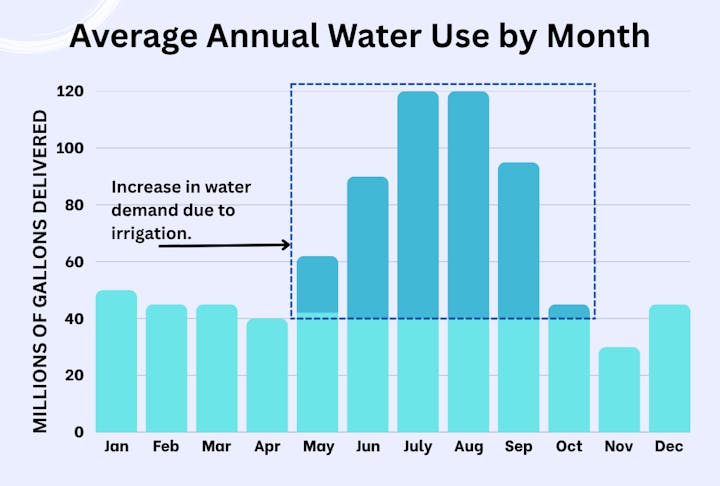
Every summer, water use in the community doubles due to outdoor irrigation on landscaped areas around homes and businesses.  In fact, during the summer months, between 50% and 100% of the water supplied to the community goes on lawns, shrubs, and flowers.  This water is removed from our aquifer and Mammoth Creek to keep lawns and other plants green.  Please do your part to water responsibly outdoors.  Making use of the following water saving tips will help you create a beautiful, drought tolerant landscape, reduce your water use significantly, and save money on your water bill.

  • Limit outdoor watering to the hours between 5pm and 10am. Watering between during this time reduces evaporation and maximizes the ability to water to reach plant roots.

  • Fix leaky hoses and hose connections

  • Adjust all sprinklers so that they are watering plants, not driveways, sidewalks, or roads.

  • Outfit all hoses with automatic shut-off nozzles.

  • Hand water with a hose when possible – homeowners who practice hand watering generally use one-third less water than those who use automatic sprinklers.

  • Add compost or peat moss to soil to improve its water holding capability and discourage weeds.  Additionally, mulch beds to a depth of two or three inches to reduce evaporation.

  • Plant drought-tolerant plants or grasses instead of using turf.  Drought tolerant plants and grasses are beautiful and use only a fraction of the water used on conventional grasses.  Contact local landscape contractors and nurseries for information regarding native and drought tolerant plants and irrigation system design.

Indoor Conservation Tips


There are many ways to save water and they all start with you.  Here are some useful suggestions to save water inside the house.  Remember, by conserving water, you are preserving our watersheds and saving your household and business money!

  • Check household toilets, faucets, and pipes periodically for leaks.  A leaky toilet can waste thousands of gallons of water per month and leaky faucets can waste up to 15 gallons/day or 5,460 wasted gallons of water per year!

  • Only run dishwashers and washing machines when full.

  • Do not use water to defrost frozen foods.  Defrost foods in the microwave or plan to defrost overnight in the refrigerator.

  • Turn off faucet when brushing teeth, shaving, or washing your face.  You can save up to 5 gallons of water for every minute the faucet is turned off!

  • Take shorter showers.  Reducing shower time by one minute can save up to 1000 gallons of water a year.

  • Chill drinking water in refrigerator instead of letting faucet run until water is cool


Last Updated 06/25/2010     Mammoth Community Water District Copyright © 2006      webmaster        Contact Us